
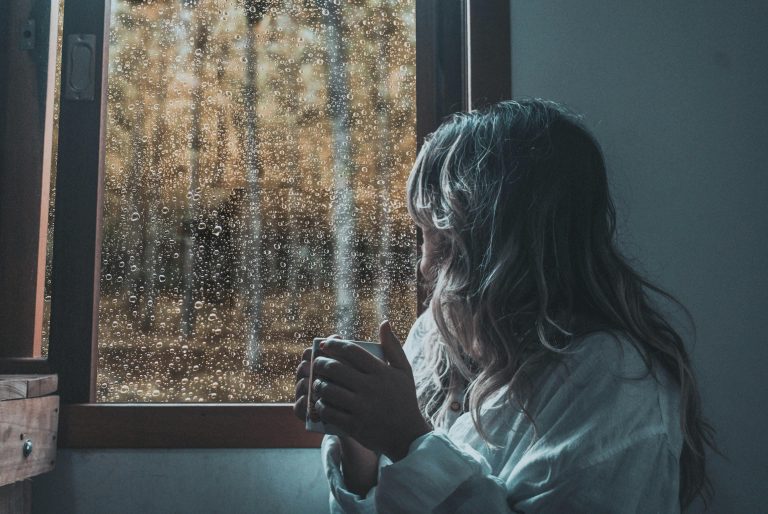
Alice lugs her duffle bag up the stairs of the bus and bumps down the aisle until she gets to the back row of seats. Hers is the first stop on the route, and it’s pre-dawn. Her eyes adjust to the sharp interior lights. The freshly applied antiseptic cleaner is not fully covering the smell of body odour and vomit from the last trip. It’s a bus for long trips, with padded airplane style seats, seatbelts and mesh pockets for storing little snacks and trashy magazines, or water bottles and novels, or phones and headphones, depending on the traveler.
Alice hadn’t considered onboard entertainment when she packed. She only has the rolled-up art magazine she took from her daughter’s dance studio the day before. She takes it out of her purse and puts it in the seat pocket. The severe but beautiful face on the cover stares back at her. Alice slouches back in her chair and pulls her baseball cap down over her eyes.
There is no one else on the bus yet, and she enjoys the relative solitude. She has put her bags on the seat next to her to signal to everyone else who will board that she is not open for conversation. Her daily life is such a deluge of social demands with her girls, husband, and work that the sensory deprivation of being driven across the province alone in the back of a bus feels luxurious. Before settling in, she looks at her phone; five texts from her husband, Kyle.
5:30 am: Hi Babe. Have a great trip. Don’t worry about anything here – I’ve got it. Love you! <B <B <B
6 am: Thinking of you. Did you make it to the bus okay? Just going to wake the kids up.
6:17 am: Do you know where Kylie’s water bottle is?
6:21 am: NM, found it.
6:26 am: Kendra is missing you. Sorry, I want to give you space. Are you up for a quick call with her?
Alice sighs and dials home. “Hi baby. How’s it going? . . . Did you have breakfast? . . . What, pancakes on a Wednesday? Lucky! Dad’s the best, eh? . . . Aw, I miss you too. Have an amazing day at school. Love you!! Can you put your dad on? . . . Hey, sweetheart, thanks again for doing everything so I can make this trip. I love you so much. I just want to let you know I’m going to turn my phone off for a while. I’ll get in touch if I need to . . . no, no, everything is okay. I just need to focus here . . . I know, sorry . . . ok, gotta go.” Alice quickly hangs up and turns her phone off before she can second guess herself. She’s cutting a cord that attaches her to home. It hurts, but she needs to be alone now.
She pulls out a sketchbook and, bracing it on her thigh against the movements of the bus, she draws herself tied to the ground like in Gulliver’s Travels, but instead of Lilliputians, it’s her family holding the ropes pinning her down.
She gets lost in the drawing, so when the air shifts and she hears the scuffling of someone in her near proximity, she feels annoyed.
Tilting her chin up to see from under her hat, Alice sees a young woman who mirrors her expression of disdain at finding someone else in the “do not disturb” section of the bus. The woman thunks into one of the available back seats. Alice lowers her face quickly, not wanting to invite any interaction. But as usual, her curiosity overcomes her, and Alice starts sneaking glances at this woman who smells of lilacs and cigarette smoke.
The woman is about twenty, maybe younger. Her hair is dyed a severe dull black. She has piercings all along the lobe of her ear, a hoop in the septum of her nose, and another piercing pretending as a beauty mark in her cheek. Her makeup is cakey, making her skin look sallow against the dark eyeliner and red lipstick that punctuate her impish features. She wears an oversized black hoodie with patches, and a pleated plaid skirt ends mid thigh to torn fishnet stockings. Scuffed, thick-soled Doc Martin boots finish the look.
Alice smiles inwardly and looks away. Is she really old enough that young people are bringing back fashions from her youth?
She looks at her own unimaginative loose blue jeans, sneakers, and grey sweatshirt. Clothes that say nothing about her. Well, that’s not true, they say: I don’t care, don’t look at me, I’m just like everyone else. Even her clothes being clean suddenly seems boring.
“What?” the woman says. Her voice is huskier than Alice expects. Her thin plucked eyebrows are raised high.
Alice is staring, she realizes with embarrassment.
“Oh, sorry. Nothing. Uh, I like your skirt.”
The woman snorts.
“Really? Is that what you’re going with? I like your skirt? How original.”
This readiness for confrontation shocks Alice. She is not used to people unabashedly saying what they think. She is equally surprised to find herself ready, even eager, for conflict.
“Well, I didn’t want to say that you looked like a played-out garage band groupie from my youth. Can’t you young people think of something new?”
Alice is shocked by her words and immediately wants to pull them back. What is she doing?
“Ok, hello. There she is,” the woman says, smirking like she has coaxed a secret out of Alice. Amusement lights her eyes.
Alice, flustered, tucks her chin back into her chest and turns away. When she finally peaks again, the woman is looking out the window, totally disinterested in her.
The bus stops two more times roadside before pulling into a Tim Hortons parking lot.
“You’ve got exactly 10 minutes for a break,” the bus driver says, opening the bus door.
The smattering of passengers now on the bus rise and stretch, shuffling off the bus. Alice follows stiffly.
When Alice comes back outside after using the bathroom and grabbing a small coffee, she sees the woman standing behind the bus, smoking. Alice hasn’t smoked since getting pregnant with her first daughter thirteen years ago, but seeing this paragon from her youth shrouded in angst and potential, she wants one.
“Hey, can I bum a smoke?”
Again, those thin black eyebrows raise, and a knowing smirk transforms the woman’s expression to one of interest. She passes Alice the pack and a bright pink lighter.
“I’m Alice.”
“Lara,” she says, raising her chin in a nonchalant nod.
Alice’s mind shuffles through the various banalities she could say. How are you? Where are you going? Sorry for what I said earlier. Sorry for being here and trying to talk to you. What’s your story? Nothing seems right, so Alice stands there dumbly. She is grateful to have something to do with the cigarette, even though the smoke itself gags her.
Lara appraises her with a broadening smile.
Alice smiles back self-deprecatingly, and before she knows what is happening, both of them are laughing. Not shy giggles, but the belly deep cackles of old friends.
The call of the bus driver to re-board cuts them short, and quickly crushing the half-smoked cigarette on the ground, Alice files back onto the bus with the other passengers. Lara stays behind to finish the last few puffs of her smoke. Back in her seat, Alice leans back and closes her eyes, settling in for another stretch of silence and eye-contact avoidance. But before the bus is even moving, the warmth of Lara’s arm brushes against her as she crowds into Alice’s personal space.
“Wow,” Lara says, grabbing the magazine from Alice’s seat pocket. “Have you read this article about Gracie Wickman?”
“Uh, yeah. I’ve read it.”
Lara looks admiringly at the face on the cover.
“I can’t believe you have a copy of G.A.C. I didn’t think anyone east of Commercial Drive read this magazine.”
“Oh, yeah, well, it’s a fluke I even found it. I haven’t read it in years, to be honest. I actually went to school with Gracie.”
“Wait, what? Like, high school?”
“No, art school. We were at Emily Carr together.”
Lara looks up at her dramatically, mouth gaping.
“You went to Emily Carr at the same time as Gracie fucking Wickman? You?”
“Yeah, so what? Don’t judge a book, or whatever. . . “ Alice trails off, embarrassed by her use of cliché. “That’s actually why I’m going down – to see the exhibit. I’ve lost touch with the art scene a bit. I honestly hadn’t realized she had become such a big deal until I stumbled on this article.”
“‘A big deal’ is putting it mildly. Listen to this,” Lara flips open the magazine and starts reading. “Gracie Wickman is an icon, not just for the LGBTQ+ community as a trans artist, but for the whole West Coast art world. Her art transcends the boundaries of what is safe and comfortable.” Lara closes the magazine emphatically. “She’s fearless. I don’t think it’s dramatic to say she’s literally redefining what human beauty means. I’m obsessed. She’s why I applied to Emily Carr myself.”
“She’s always been good,” Alice says, remembering the feel of Gracie’s warm breath on her neck as they slept twined together in her single bed. When they had been inseparable studying art, making art, making love. Untethered to anything but each other and their creative processes.
“Good? Just look at some of these pieces from her latest exhibit,” Lara flips open the magazine again and holds it obnoxiously in front of Alice’s face. “These portraits. Ugh, they kill me. It’s like she somehow finds exactly what makes us unique, and yet all the same too. Like, look at this one,” she says, pointing with a chipped black painted nail to a full-page photo of a painting. Then she leans closer and abruptly pulls back the magazine to look at it more closely.
“Oh my god, this is you, isn’t it? When you were younger,” she says, looking dramatically back and forth between the magazine and Alice.
Alice grabs for the magazine, but Lara pulls it away and keeps reading.
“This painting is called ‘Love With No Strings Attached.’”
Tears are brimming in Alice’s eyes now. She feels too exposed.
“Holy shit, you didn’t just go to school together. You were with Gracie Wickman?!”
Alice finally grabs the magazine and stuffs it back into her purse.
“So how do you go from being Gracie Wickman’s lover and muse, to this.” she says, looking Alice up and down, cringing.
“Never mind,” Alice says, crossing her arms tightly.
“No, I’m sorry. I’m being an ass. I just wonder how people get from interesting lives to boring ones.”
“Wow, thanks,” Alice says.
“Oh damn, that came out bad. What I’m trying to say is most older people I see seem, I don’t know, beige. Yet most people my age are ripping it up and breaking down walls. What’s the trap?”
Alice looks at Lara, with her hope and promise, and sees herself twenty years earlier.
“Fuck. You’re not wrong. You know what it is? It’s not complicated. It’s mostly fear. When Gracie started transitioning to female, we were still in love. I didn’t even lose attraction for her, even though I identify as straight. She was so vital and sure of herself. She was amazing.” Alice takes a deep breath, eyes shuttering. “But there was this one time I came into the bathroom and Gracie was using my mascara. Our whole lives flashed in front of me. I imagined getting married, two white dresses. Having kids, two moms. Dealing with looks from people when we were introduced together. I thought I was so avant garde, free, not bound to conventional norms and culture, but it turns out I’m not that brave.”
Alice looks up and is relieved to see no judgement on the young woman’s face, just sympathy, and some sadness. Alice pushes on.
“Gracie sensed the shift and encouraged me to take some space to get clarity. I went home to the Kootenays for summer break. I met Kyle and got pregnant. I never went back. Coward.”
Tears stream down Alice’s face now, and Lara stares at her gaped mouthed.
“So much of middle age is living out the choices we make in our youth, when we’re not thinking about consequences.”
“Are you going down to reconcile with Gracie, then?”
“I don’t know what I’m doing. When I saw Gracie on the cover, I had to come. Kyle is amazing. He knows about Gracie. He encouraged me to make this trip. We have a great life, but he knows I’ve killed a part of myself to have it. He wants me to be happy.”
It’s four in the afternoon when the bus arrives in Vancouver. Alice and Lara disembark together and find the connecting city bus to Granville Island at the terminal. It’s cold and drizzling, typical of Vancouver in September, and they huddle together under Alice’s umbrella waiting to board. Alice enjoys the familiar smell of rain on pavement and the sound of many cars, the SkyTrain, and seagulls.
Once they get off the bus at Granville Street, Alice guides Lara confidently on the footpath under the overpass, past the colourful murals and through the twisty streets of the island. It’s like she’s never left. Gracie’s exhibit, “The Ties that Bind,” is in the Primouth Gallery, which is accessible only by walking through the market. The competing smells of flowers, fish, and fresh pastries invigorate Alice, and she smiles at the look of childlike awe on Lara’s face. The first time at the Granville Island Market is an experience for everyone.
When they get to the harbour and the gallery comes into view, Alice stops. Even though they aren’t close yet, she sees the unmistakable tall and lithe silhouette of Gracie inside, talking to a patron. Alice would know that body anywhere. How can all the love and magnetism still be there, even now? Alice starts to crumple inside.
“Hey, are you okay?” Lara asks, pulling at her elbow.
“Uh, yeah. You know? You go ahead. I have to make a call.”
“Are you sure? You look pretty pale.”
“Yeah. I’m fine. Go on.”
As Lara walks towards the gallery, Alice calls to her.
“It was . . . I don’t know . . . good to meet you.”
Lara smiles at her, unguarded, and then turns back towards the gallery. Alice calls her again.
“Hey, don’t forget what I told you. Be fearless.”
Lara’s smile broadens, and she raises her fingers to her forehead in a mock salute.
Alice stands in the rain looking into the gallery for a long time before she eventually takes her phone out and turns it on. Only one text message:
5 pm, Kyle: I hope you get what you need. I love you.
She left Gracie once out of fear. In that fear, she bound herself with family ties that she could . . . would, never walk away from.
She taps her blue sketching pencil absently on the back of her phone. When had she pulled it from her purse? Sighing, she slowly turns from the gallery and dials home.
About the Author
Chelsey is a 42-year-old working mother of two young teenage boys with a homestead living ultra remotely in Argenta. Despite the inevitable tension of so many competing interests, and perhaps due to a midlife crisis, she is now rabidly pursuing her art in creative writing after 20 years of pretending to do other things. She writes mostly long-form literary fiction and short stories, and occasionally some questionable poetry.