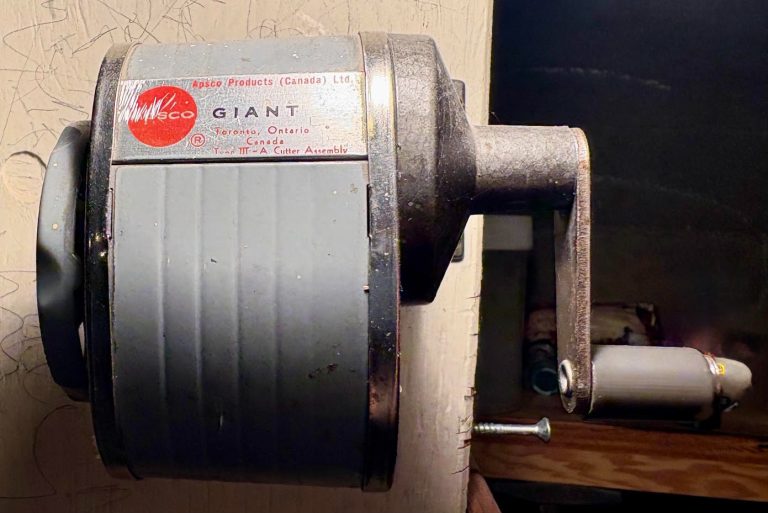
It was a sacred object in every classroom of my suburban Toronto schools. A vehicle for self-actualization in an otherwise regimented day. Though I was not permitted to speak unless spoken to, to colour outside of the lines, or even to satisfy my most basic of human needs without first obtaining permission, I could, at my discretion, leave my desk and make the pilgrimage to the back of the classroom where the Berol Giant Apsco Sharpener was mounted on the wall.
I always approached this sacred object with due reverence. It was a feast for the senses: visual, tactile, auditory and olfactory. Looking upon the Berol Giant, I was always struck by the perfection of its design, its beguiling mechanical nature and its willingness to satisfy my need to exert control over it.
I remember its shiny brown bracket that might be mounted by screws on the wall or, less often, on a shelf. The body or casing was of a more subdued brown metal in an oval drum shape with one end wider than the other that gave it a pleasing asymmetry. This casing housed the grinding mechanism that was comprised of two metal grinders that rotated maniacally towards a central space into which the pencil was inserted. The casing served to enclose these grinders and to catch the pencil shavings. It was always imperative to remove the casing and inspect the grinders as they rotated neatly into each other with a profoundly satisfying precision. By turning the crank handle, I could control the speed at which the grinders turned and subsequently the speed at which my pencil was sharpened or ground away to shavings, should I get carried away by the sheer delight of the process. Afterwards, it was usually necessary to twist the casing off and deposit the shavings into the garbage can, often accompanied by a resounding tapping of metal on metal for best effect. Then the casing had to be carefully slipped back over the grinders and twisted into place with a satisfying click.
At the opposite end from the handle was the six-hole pencil guide that you could rotate to match the width of your pencil. The correct selection of the hole-width was crucial for achieving the sharpest pencil tip while conserving as much of your pencil as possible. Too wide a hole and your pencil had excessive play in the grinders reducing it to shavings in no time. The largest hole accommodated the thick blue pencils used in the primary grades, and it was a bittersweet milestone when I graduated from these jolly blue pencils to using the slender orange HB number two pencil that no longer required the sharpener’s largest hole.
I remember the aromatic smell of cedar from the pencil shavings as they were tipped into the garbage and their intricate fan shape, black and sooty on the lead edge and a glossy orange on the other. The shavings frequently collected on the floor below the sharpener, and there was a fine coating of wood dust and pencil lead over everything near where it was mounted.
And then there was the sound! The whirring, grinding sound as the pencil was shaved away, as the grinders spun and the crank handle was turned with a fury only a grade school student could command. A happy, industrious sound that filled us with resolve to write our own pencil leads down to a dull nub that we too might take our rightful place in the line at the back of the classroom and sharpen our pencils to a fine point once more. But then there was that other sound. The sound of a pencil being jammed in the grinders, the jarring discord of the mechanism as it struggled with its task and the inevitable cursing under the breath of the student who reddened as they tried to adjust the hole guide and realign their pencil correctly, knowing that everyone in the room was aware of their clumsiness, their failure to operate the sacred device with the skill that it deserved.
Years later, I have an electric pencil sharpener that sharpens even the poorest quality of pencil with speed and with a tedious reliability and makes a high-pitched whizzing sound reminiscent of a dentist’s drill. Modern brands of mechanical sharpeners imitating the Apsco boast “pencil saving features that prevent over-sharpening”, “anti-microbial protection” and “ergonomic grips for ease of use.” But none of these will take the place of the Berol Giant Apsco Sharpener of my youth.
About the Author
Jill Johnson lives in Kimberley where she draws inspiration for her writing and painting from hiking, skiing and paddling throughout the wilderness of the traditional and unceded territory of ʔamakʔis Ktunaxa.
A founding member of the Kimberley Friends Art Collective, she has participated in creative writing workshops and published poetry and prose in a community collection by the SUFYA Collective.